Reviewers Who Don't Share Blind Spots
AI + Developer Tools
I published an essay arguing that delegation interfaces are the defining design problem of agentic AI. Then I built one: revue sets up AI code review on any repository in about a minute, with reviewers on different model families so writer and reviewer never share blind spots, and dismissal that only a human can confirm.
Role
Designer & Builder
Duration
June 2026 (v0.1.1 in four days)
Tools
Python
Claude
OpenRouter
GitHub Actions
Claude Code
A reviewer who doesn’t share my blind spots
This year most of my code is written with coding agents, and that created a problem the tooling hadn’t solved for me: having Claude review Claude’s code is structurally bad. A reviewer that shares the writer’s blind spots isn’t a reviewer, it’s a second signature. And the SaaS alternative, a monthly fee plus per-PR overage, is real money once you ship one tool a week across a dozen repos.
So I built revue: a CLI that bootstraps AI code review on any repository in about a minute, for five to fifteen cents per pull request.
How it works
Running revue init finds your project spec, sends it to Claude to generate three context documents (what this project is, what its standards are, what its security posture should be), provisions a dedicated per-project API key so cost is attributed where it belongs, and opens a pull request adding the workflows. A human reviews and merges that PR, because of course they do.
From then on, every pull request gets three visitors. A logic reviewer flags correctness bugs. A security reviewer, running a different role and prompt, flags vulnerabilities. And a dismissal suggester, running on a different model family entirely, evaluates their findings against the project context and surfaces likely false positives.
The model diversity is the point: reviewers and writer must not share blind spots. One model writes, another family reviews, a third judges the reviews. A council of models, with one deliberate asymmetry.
The checkbox is the design
The suggester can say a finding is probably a false positive. It cannot dismiss anything. Dismissal is a checkbox, and only a human can tick it. Models bias toward themselves, and a system where AI both raises and waives concerns has quietly removed the human from the only seat that matters.
In the taxonomy from my delegation interfaces essay, revue implements the full loop: commissioning (init and the context documents), monitoring (every PR reviewed), review (the two reviewers), intervention (the checkbox), and governance (per-project keys, cost attribution, and a human on every merge).
Does it actually catch things?
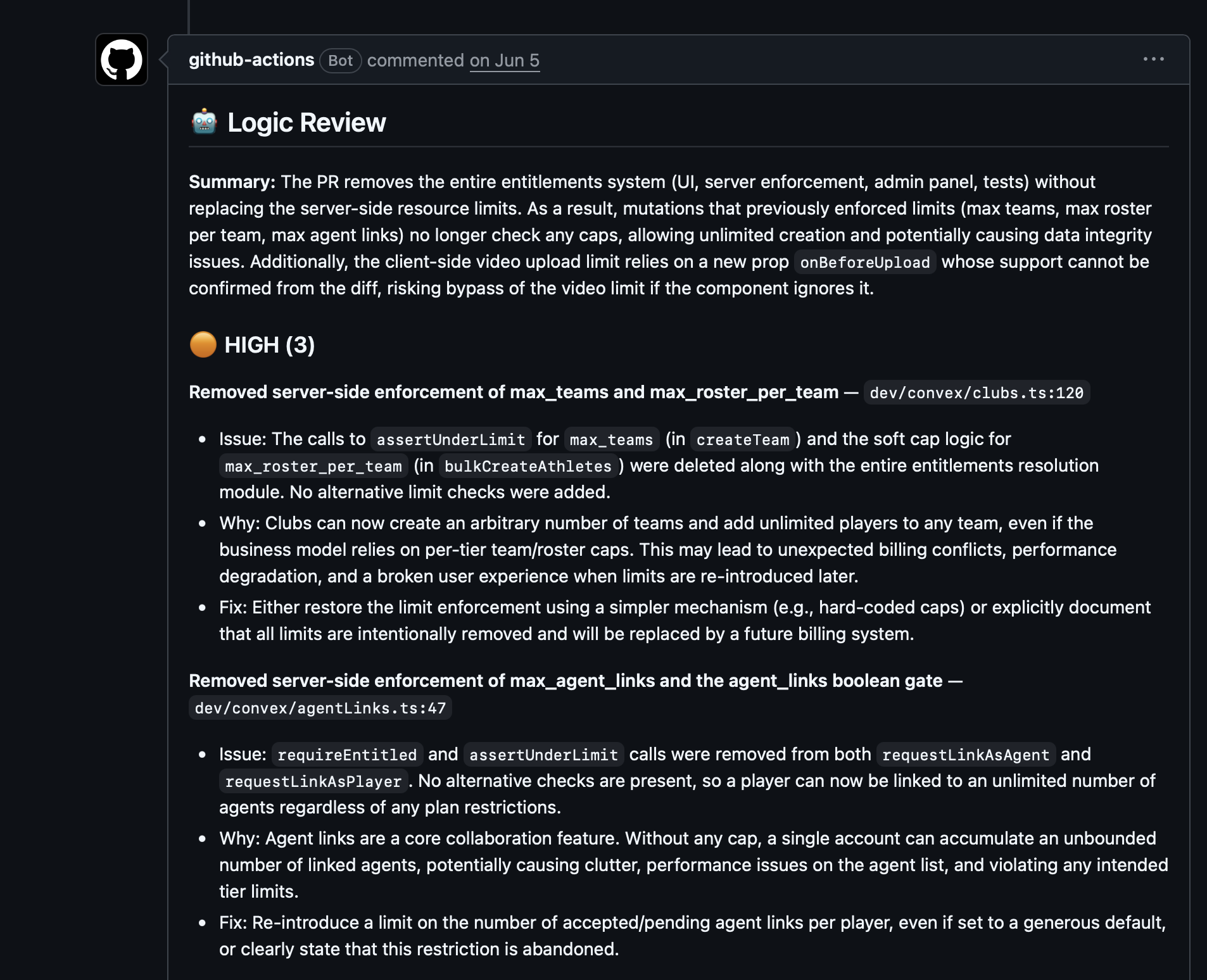
Yes, verifiably. On one of my products, revue’s logic reviewer caught a data-loss bug: a theme switcher silently overwriting users’ existing color customizations. In another PR it flagged that removing an entitlements system had also removed the server-side resource limits, leaving mutations uncapped, complete with the why and a suggested fix. The security reviewer runs alongside on every PR, confirming the boring things that should stay boring.
Every repository I run is reviewed this way now.
Where it stands
Built for myself, public for anyone: installable with one command, released as v0.1.1 four days after the first commit. It’s the smallest complete example I have of the thing I keep writing about: the design problem in agentic systems isn’t the model. It’s the trust architecture. Who reviews, who dismisses, who merges, and why the human holds the checkbox.